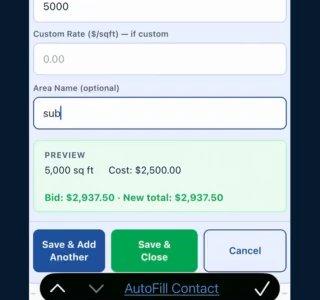
Most commercial cleaning bids don’t get lost on price — they get lost on inconsistency. Two similar buildings get two wildly different quotes because the walkthrough didn’t capture the same information both times, or because the person building the quote back at the office made different judgment calls each time. This worksheet is the checklist we’d actually use on a walkthrough: what to capture, in what order, so every bid starts from the same real information instead of memory and guesswork.
What to Capture During Every Walkthrough
Before you can price anything, you need the same core facts for every building, gathered the same way every time:
- Total square footage — broken out by space type if it varies (office vs. warehouse vs. retail floor), since different areas often need different treatment.
- Service frequency requested — daily, three-times-weekly, weekly, or biweekly. This is usually the single biggest driver of the final number.
- Facility type — office, retail, medical, government, or industrial. Each carries different supply costs, sanitation requirements, and risk.
- Restroom count — restrooms take disproportionately more time and supplies than open floor space, and get priced differently for a reason.
- Floor types and condition — carpet vs. hard flooring, and whether floor care (stripping/waxing, deep carpet cleaning) needs to be quoted separately from routine service.
- Access and timing constraints — after-hours access, security/badge requirements, and any restricted areas that affect how long the job actually takes.
- Current pain points — if they’re replacing an existing vendor, what’s actually driving that decision. This shapes what you emphasize in the proposal, not just the number.
Turning a Walkthrough Into a Number
Once you have consistent inputs, the calculation itself should follow the same structure every time:
- Start with a base rate per square foot, scaled to the requested service frequency. More frequent service costs more in total but should cost less per visit — if your math doesn’t reflect that, something’s off.
- Apply a facility-type adjustment. A medical office or industrial facility isn’t priced the same as a standard office, because the actual work and risk aren’t the same.
- Add restrooms as a flat per-restroom fee on top of the base rate, rather than folding them into the square-footage number.
- Quote floor care separately, with its own minimum per visit, rather than trying to average it into the monthly rate.
- Apply a minimum job size. Every company has a square-footage and dollar floor below which a job isn’t worth taking at any frequency — know yours before you’re standing in the lobby.
The exact rates are yours to set based on your labor costs, market, and margin targets — the point of the structure isn’t the specific numbers, it’s that the same inputs always produce the same output, regardless of who’s doing the walkthrough.
Common Mistakes That Cost the Bid
A few patterns show up again and again in lost bids that had nothing to do with being too expensive:
- Slow turnaround. A prospect getting bids from three companies tends to read a week-long delay as a preview of how responsive you’ll be as a vendor.
- Inconsistent numbers. If a facilities manager compares notes with another property in your portfolio and the math doesn’t line up, it raises questions you don’t want to answer.
- No follow-up plan. A quote sent into email silence loses to a company that calls back two days later with an answer to a question the prospect didn’t even ask yet.
- Underestimating restrooms and floor care. These are the two line items most commonly low-balled in a rushed walkthrough, and the two most likely to erase your margin over the life of the contract.
Making This Repeatable
The companies that win bids consistently aren’t necessarily the cheapest — they’re the ones whose quoting process doesn’t depend on who happens to be doing the walkthrough that day. Whether that’s a shared spreadsheet template, a printed checklist, or a tool that calculates the number on the spot, the goal is the same: the same building should produce the same bid no matter who’s standing in it.