
3 min read
Most cleaning companies grow the same way: a handful of accounts run fine on personal relationships and manual scheduling, and then somewhere between five and fifteen accounts, the informal system that worked stops working. Shifts get double-booked, supply requests get lost in a group text, and the owner becomes the single point of failure for information that should live somewhere everyone can see.
Recurring Work Shouldn’t Require Re-Entering the Same Shift
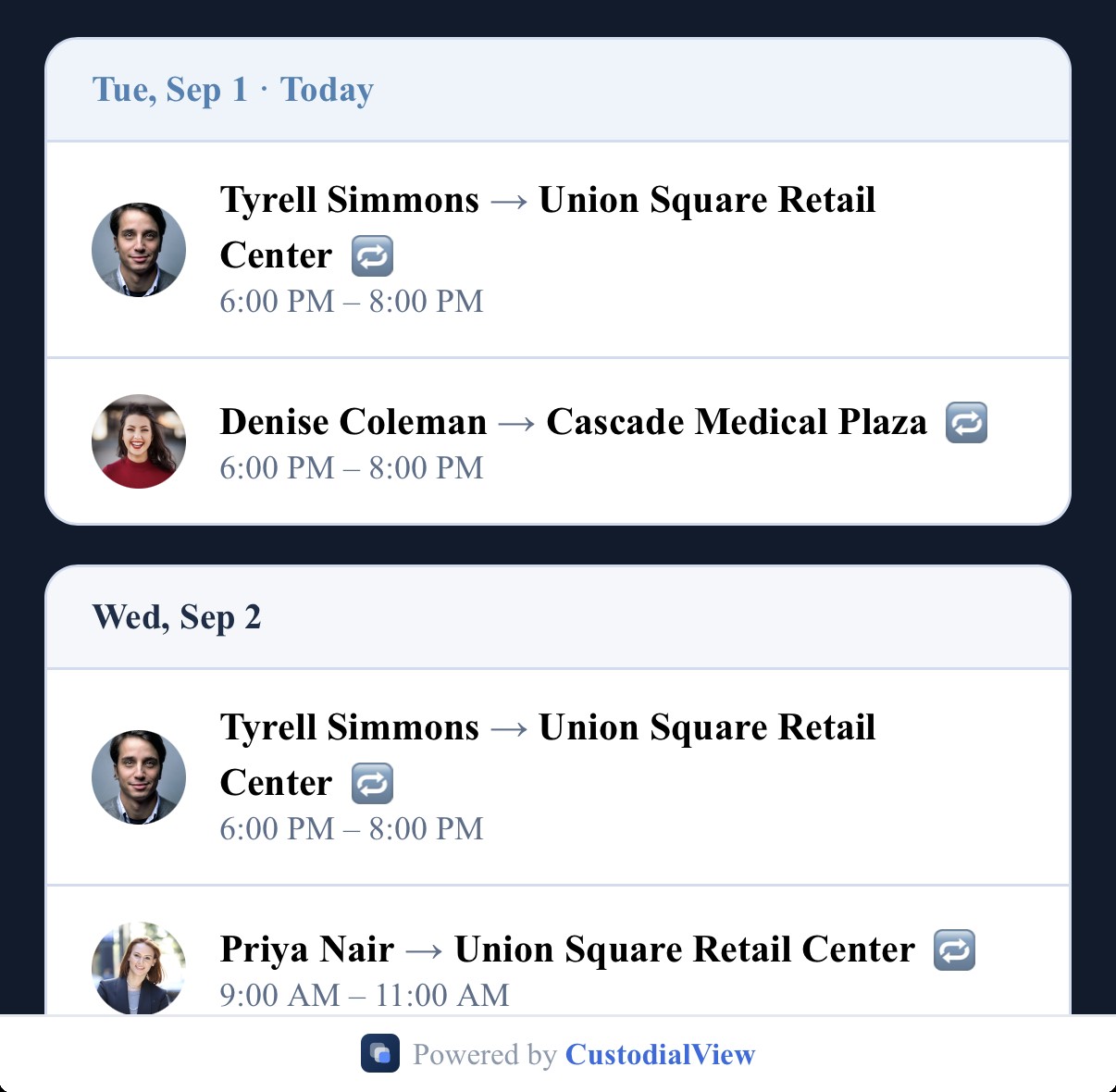
Commercial cleaning contracts are mostly recurring — the same site, the same crew, the same time, week after week. Scheduling software that treats every visit as a one-off event means someone is manually re-entering the same shift every single week, which is exactly the kind of repetitive task that gets skipped, duplicated, or entered wrong when things get busy. A schedule that’s built once as a weekly, biweekly, or monthly pattern and then just runs — pausable and resumable without rebuilding it — removes an entire category of scheduling errors before they happen.
Supply Management Is an Operations Problem, Not an Afterthought
Running out of trash liners or floor cleaner mid-shift is a small problem that becomes a big one when it happens at a client site and nobody finds out until the next day. The standard fix — a crew member texting a photo of an empty shelf to whoever manages supplies — works, but it depends on that message reaching the right person and not getting buried. Routing supply requests as a structured flag with a photo, straight to whoever actually restocks, closes the gap between “we’re out” and “someone knows we’re out.”
Why Manual Systems Break at a Predictable Point
The breaking point isn’t really about employee count — it’s about how many things one person is expected to track in their head. A company with five accounts and one owner tracking everything personally often runs smoother than a company with fifteen accounts trying to use the same informal system, because the informal system was never designed to hold that much information. The fix isn’t necessarily more staff; it’s moving the information out of someone’s head and into something the whole team can see and act on.
What Growth Actually Requires Operationally
Scaling a cleaning business past the owner-does-everything stage requires three things to exist somewhere other than one person’s memory: who’s scheduled where and when, what’s been completed and by whom, and what each site needs to keep running smoothly. None of that requires more headcount to solve — it requires those three things to be visible to the people who need them, not just the owner.
Where to Start
Most companies don’t need to overhaul everything at once. Fixing recurring scheduling alone removes a weekly source of errors; adding a structured way to flag and route supply needs removes a second. Both are narrow, specific fixes — not a full operations overhaul — and either one tends to free up enough of an owner’s time to actually work on growing the business instead of just running it.
Ready to give your clients a portal like this?
Live in minutes, no developer required. 14-day free trial, no card required.
Start Free Trial See Pricing
Leave a Reply