
4 min read
Time theft and no-shows represent two of the most persistent challenges for commercial cleaning companies. When a crew member clocks in before actually arriving at a job site or simply doesn’t show up for their shift, it creates a cascade of problems: inflated labor costs, unfulfilled client expectations, and the operational headache of scrambling to cover assignments at the last minute.
Unlike businesses where managers work alongside employees throughout the day, cleaning operations typically involve crews working independently across multiple sites during evening or overnight hours. This structure makes these issues particularly difficult to detect and address. Understanding why they happen and implementing practical systems to prevent them is essential for protecting both your profitability and your reputation.
Why Time Theft Happens in Cleaning Operations
Time theft in the cleaning industry rarely stems from outright dishonesty. More often, it develops gradually from poor systems. When employees use a shared login code or call a central number to clock in, there’s no way to verify their actual location. A crew member stuck in traffic might clock in from their car, intending to make up the time later. Once that boundary is crossed without consequence, the behavior can escalate.
The lack of accountability also plays a role. If supervisors can’t easily verify when and where employees actually started work, employees naturally test the boundaries of what they can get away with. This is human nature in any unsupervised environment.
The True Cost of No-Shows
No-shows create immediate operational chaos. You receive a frustrated call from a client about an uncleaned facility right as you’re trying to coordinate coverage from crew members who are already assigned elsewhere. Beyond the immediate scramble, no-shows damage client relationships, force you to pay overtime to cover gaps, and create resentment among reliable employees who must pick up the slack.
Chronic no-shows often indicate deeper issues: transportation problems, childcare challenges, or an employee who’s already mentally checked out. The key is identifying patterns early before they disrupt multiple job sites.
Prevention Strategies That Actually Work
The most effective approach combines clear policies with verification systems that make time theft difficult and no-shows immediately visible.
Start with transparent expectations during onboarding. Employees should understand exactly when they’re expected to clock in (at the job site, not during the commute), the consequences of time theft or no-shows, and how their attendance is tracked. Put this in writing and have new hires acknowledge it.
Implement location-verified time tracking. The technology exists to require employees to check in from the actual job site using their smartphone. Photo check-ins serve a dual purpose: they verify the employee is on-site and create a visual record of facility conditions at shift start. This single change eliminates most accidental and intentional time theft.
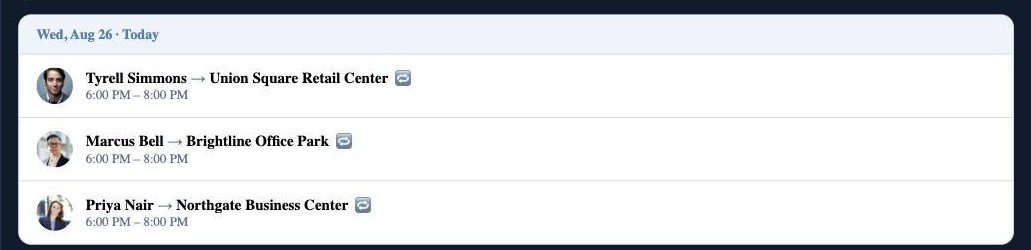
For scheduling, move away from manual weekly schedules. Establish recurring shift assignments that employees can see weeks in advance. When people know their schedule reliably repeats, they can arrange their personal lives around it, reducing no-shows caused by confusion or conflicting commitments.
Create a culture of accountability by addressing issues immediately. If someone clocks in before arriving, have a conversation that same day, not three weeks later during a review. Quick, consistent responses to small violations prevent them from becoming normalized behavior.
Technology as an Enforcement Tool
Manual tracking systems—whether paper timesheets or honor-system phone calls—simply can’t provide the verification needed in a distributed workforce. You need real-time visibility into who’s actually working, where, and when.
Modern solutions designed specifically for field service companies build verification into the clock-in process itself. For example, CustodialView requires employees to take a photo at the job site when clocking in, automatically capturing the time and location. Managers receive instant notifications if a shift goes uncovered, allowing them to address no-shows within minutes rather than discovering the problem the next morning. The system also handles recurring shift scheduling and provides clients with a branded portal where they can see exactly when their facility was serviced, building trust while keeping your team accountable.
The goal isn’t to create a punitive environment where employees feel distrusted. It’s to implement clear systems that make expectations obvious, violations impossible to miss, and accountability automatic. When your team knows that time theft will be caught immediately and no-shows will trigger instant alerts, behavior shifts naturally—and you can focus on running your business instead of policing timesheets.
Ready to give your clients a portal like this?
Live in minutes, no developer required. 14-day free trial, no card required.
Start Free Trial See Pricing
Leave a Reply